If this is your first home purchase, oil tanks may be a brand-new concern. This plain-language guide brings you up to speed.
Why this matters in New Jersey
New Jersey's long history of oil heat means buried tanks turn up constantly — and the financial and environmental consequences of missing one are significant. That's the backdrop for everything in this guide.
Key things to know
- A professional sweep scans the whole property, not just a small perimeter.
- The visual inspection is as important as the equipment — clues matter.
- A clear written report is what attorneys, lenders, and buyers rely on.
- Timing the sweep correctly protects your ability to negotiate.
Our approach
At NJ Oil Tank Scan, we combine multiple detection methods with years of New Jersey-specific experience, then document everything in a report you can act on with confidence.
The goal isn't to alarm you — it's to give you certainty. Knowing what's underground is what lets you make a confident decision.
How the detection actually works
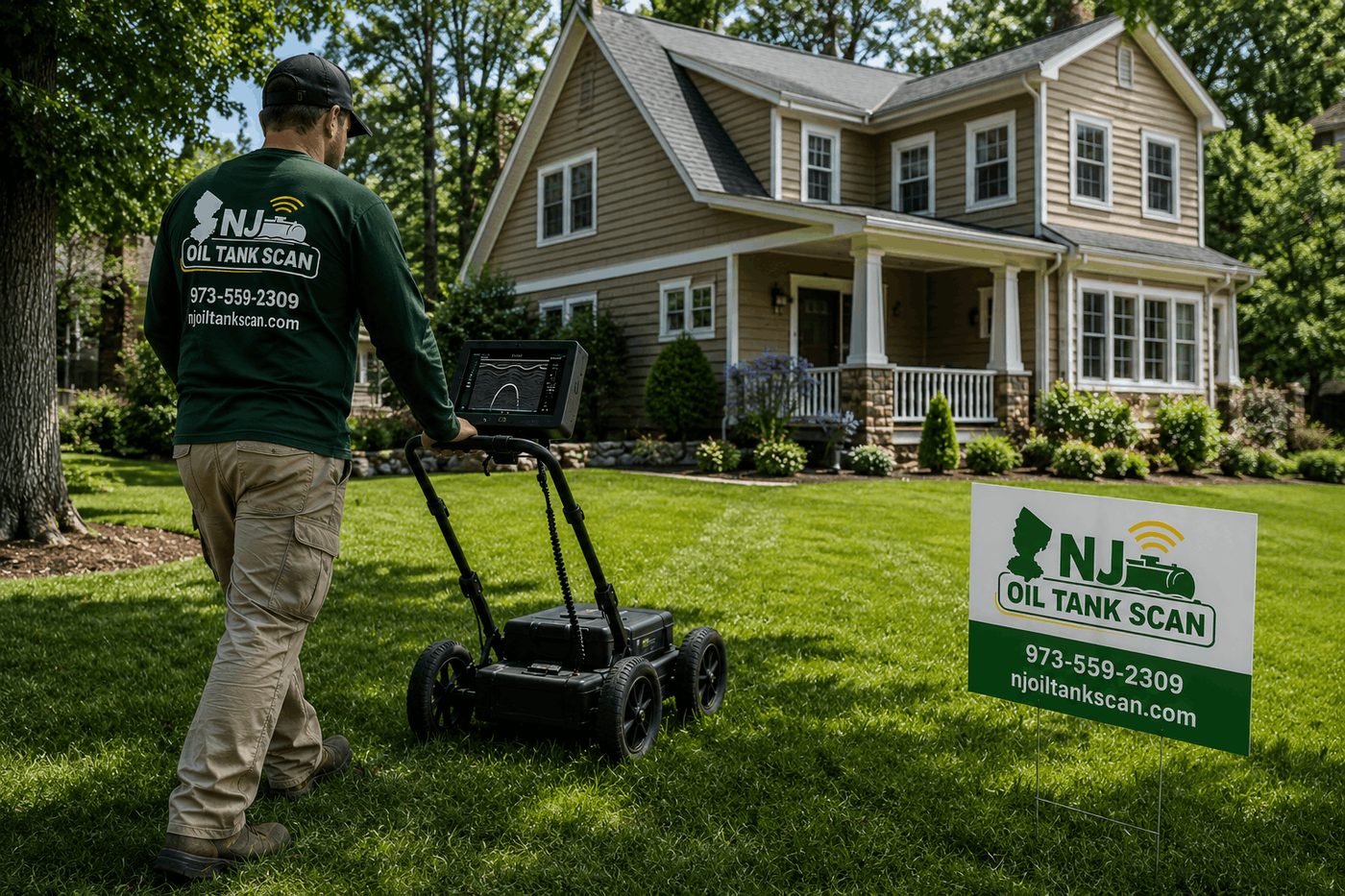
Once you see the pattern, you can't unsee it on an older New Jersey home. When paved surfaces or additions complicate the scan, ground penetrating radar images the subsurface directly to fill the gaps. Abandoned supply lines, fill pipes, and vent pipes can be traced to where a tank is — or once was.
The whole property is covered — yards, setbacks, driveways, and hardscape — not just a narrow band around the foundation. When paved surfaces or additions complicate the scan, ground penetrating radar images the subsurface directly to fill the gaps. For a time-sensitive closing, confirm same-day reporting is available before you book.
What's really at stake
If a buried tank leaked, the new owner inherits the cleanup, which in New Jersey commonly runs from eight thousand dollars into the tens of thousands. A collapsing empty tank can create a dangerous void, which is why even a non-leaking abandoned tank matters. Estimates put the number of unknown or undiscovered underground storage tanks across New Jersey well into the six figures.
Most homeowner insurance policies specifically exclude leaking-tank remediation, so the cost typically lands directly on the property owner. If a buried tank leaked, the new owner inherits the cleanup, which in New Jersey commonly runs from eight thousand dollars into the tens of thousands. Put together, the picture is clear.
Why New Jersey properties carry this risk
Northern New Jersey's dense, early-twentieth-century housing stock is exactly the profile where abandoned tanks cluster. Estimates put the number of unknown or undiscovered underground storage tanks across New Jersey well into the six figures. Abandoned supply lines, fill pipes, and vent pipes can be traced to where a tank is — or once was.
The state's environmental agency maintains records around tank closure and soil remediation that a file review can surface. Estimates put the number of unknown or undiscovered underground storage tanks across New Jersey well into the six figures. The short version is simple; the useful version takes a paragraph or two.
Putting it into practice
What does this mean in practice? On the question of “A First-Time Home Buyer's Guide to Oil Tanks in NJ,” the practical move is the same: Schedule the sweep inside your inspection contingency window so any finding can be addressed while you still have leverage. If you spot a vent pipe, capped line, or patched driveway, treat it as a reason to scan rather than a verdict on its own.
How fast can NJ Oil Tank Scan help with my property?
We cover every town in Northern New Jersey and can often schedule within a day or two, with same-day written reports when a closing date is on the line. Call 973-559-2309 for a free, no-obligation quote and we'll confirm availability for your address.
Have questions about your specific property? We're happy to talk it through and recommend the right next step. Call 973-559-2309 or request a free quote.