Tank removal and cleanup can be expensive, but New Jersey homeowners may have options to offset the cost. Here's an overview.
Why this matters in New Jersey
New Jersey's long history of oil heat means buried tanks turn up constantly — and the financial and environmental consequences of missing one are significant. That's the backdrop for everything in this guide.
Key things to know
- A professional sweep scans the whole property, not just a small perimeter.
- The visual inspection is as important as the equipment — clues matter.
- A clear written report is what attorneys, lenders, and buyers rely on.
- Timing the sweep correctly protects your ability to negotiate.
Our approach
At NJ Oil Tank Scan, we combine multiple detection methods with years of New Jersey-specific experience, then document everything in a report you can act on with confidence.
The goal isn't to alarm you — it's to give you certainty. Knowing what's underground is what lets you make a confident decision.
How the detection actually works
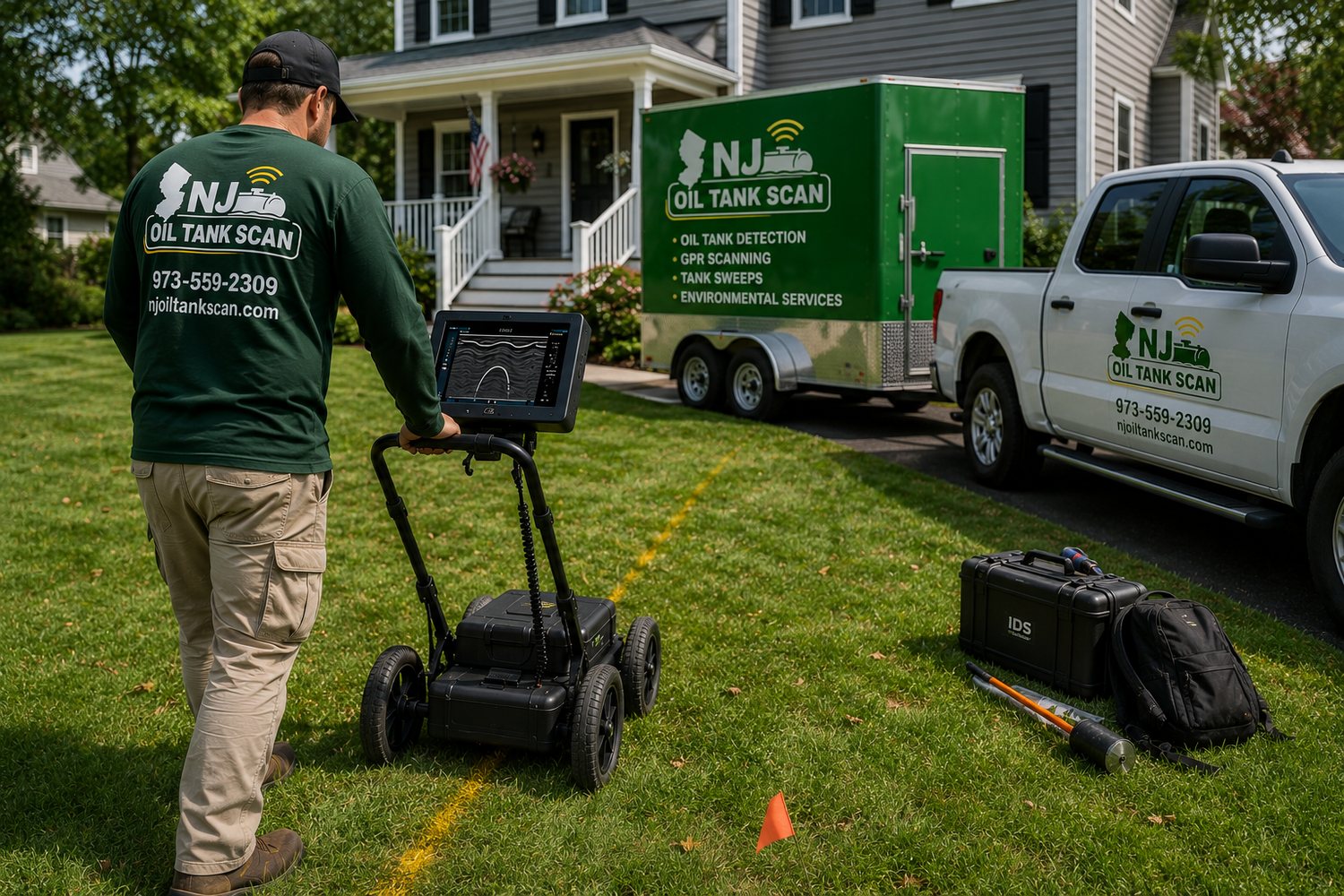
Homeowners and buyers ask about this constantly, and the honest answer rewards a little detail. Probing confirms the depth and material of any anomaly, separating a real tank from buried debris. When paved surfaces or additions complicate the scan, ground penetrating radar images the subsurface directly to fill the gaps.
A professional sweep combines a subsurface scan of the entire lot with a trained visual inspection of the home and grounds. The result isn't a guess but a documented finding, with the anomaly's approximate location and depth noted in writing. Ask any provider whether the scan covers the whole property and whether ground penetrating radar is included when needed.
What's really at stake
The longer a steel tank sits underground, the more corrosion works against it, raising the odds of a release over time. If a buried tank leaked, the new owner inherits the cleanup, which in New Jersey commonly runs from eight thousand dollars into the tens of thousands. Estimates put the number of unknown or undiscovered underground storage tanks across New Jersey well into the six figures.
Environmental responsibility attaches to whoever holds title when a release is discovered, even with no prior knowledge of the tank. Lenders and title companies grow cautious when a tank question is left open, which can complicate financing. There's a simple way to act on all of this.
Why New Jersey properties carry this risk
When homes converted to gas, the visible furnace changed but the buried tank was frequently left in place. Sellers often have no idea a tank exists because it predates their ownership entirely. A technician reads the basement for capped lines and the exterior walls for fill and vent pipes before a single reading is taken.
A tank installed in the 1960s and abandoned in the 1990s can sit silently underground while several owners come and go. Because conversions happened gradually over decades, two neighboring homes can have entirely different tank histories. It's worth slowing down on this point, because it's where most costly mistakes begin.
Putting it into practice
The takeaway for a New Jersey homeowner is direct. On the question of “Help Paying for Oil Tank Removal and Cleanup in NJ,” the practical move is the same: Get the question settled early, because certainty is far cheaper than a surprise discovered mid-transaction. Ask any provider whether the scan covers the whole property and whether ground penetrating radar is included when needed.
How fast can NJ Oil Tank Scan help with my property?
We cover every town in Northern New Jersey and can often schedule within a day or two, with same-day written reports when a closing date is on the line. Call 973-559-2309 for a free, no-obligation quote and we'll confirm availability for your address.
Have questions about your specific property? We're happy to talk it through and recommend the right next step. Call 973-559-2309 or request a free quote.