Hudson County's dense, century-old housing stock — from Jersey City to Hoboken — means underground tanks are a real and common concern.
Why this matters in New Jersey
New Jersey's long history of oil heat means buried tanks turn up constantly — and the financial and environmental consequences of missing one are significant. That's the backdrop for everything in this guide.
Key things to know
- A professional sweep scans the whole property, not just a small perimeter.
- The visual inspection is as important as the equipment — clues matter.
- A clear written report is what attorneys, lenders, and buyers rely on.
- Timing the sweep correctly protects your ability to negotiate.
Our approach
At NJ Oil Tank Scan, we combine multiple detection methods with years of New Jersey-specific experience, then document everything in a report you can act on with confidence.
The goal isn't to alarm you — it's to give you certainty. Knowing what's underground is what lets you make a confident decision.
Hudson County's dense, century-old housing
Hudson County is among the most densely populated areas in the country, with Jersey City, Hoboken, Bayonne, and Union City built out largely in row-house and multifamily stock more than a century ago. That age profile means a very high share of Hudson properties once used oil heat, often stored in tanks buried in small rear yards or beneath the structure itself. The tight urban footprint here leaves little open ground, so tanks are frequently tucked into compact spaces or under hardscape.
In Hudson's compact lots, ground penetrating radar and careful visual inspection do much of the heavy lifting, since a tank may sit beneath a paved yard, a parking pad, or close to the foundation. Multifamily and mixed-use buildings common across Jersey City and Hoboken add complexity that rewards an experienced technician.
How the detection actually works
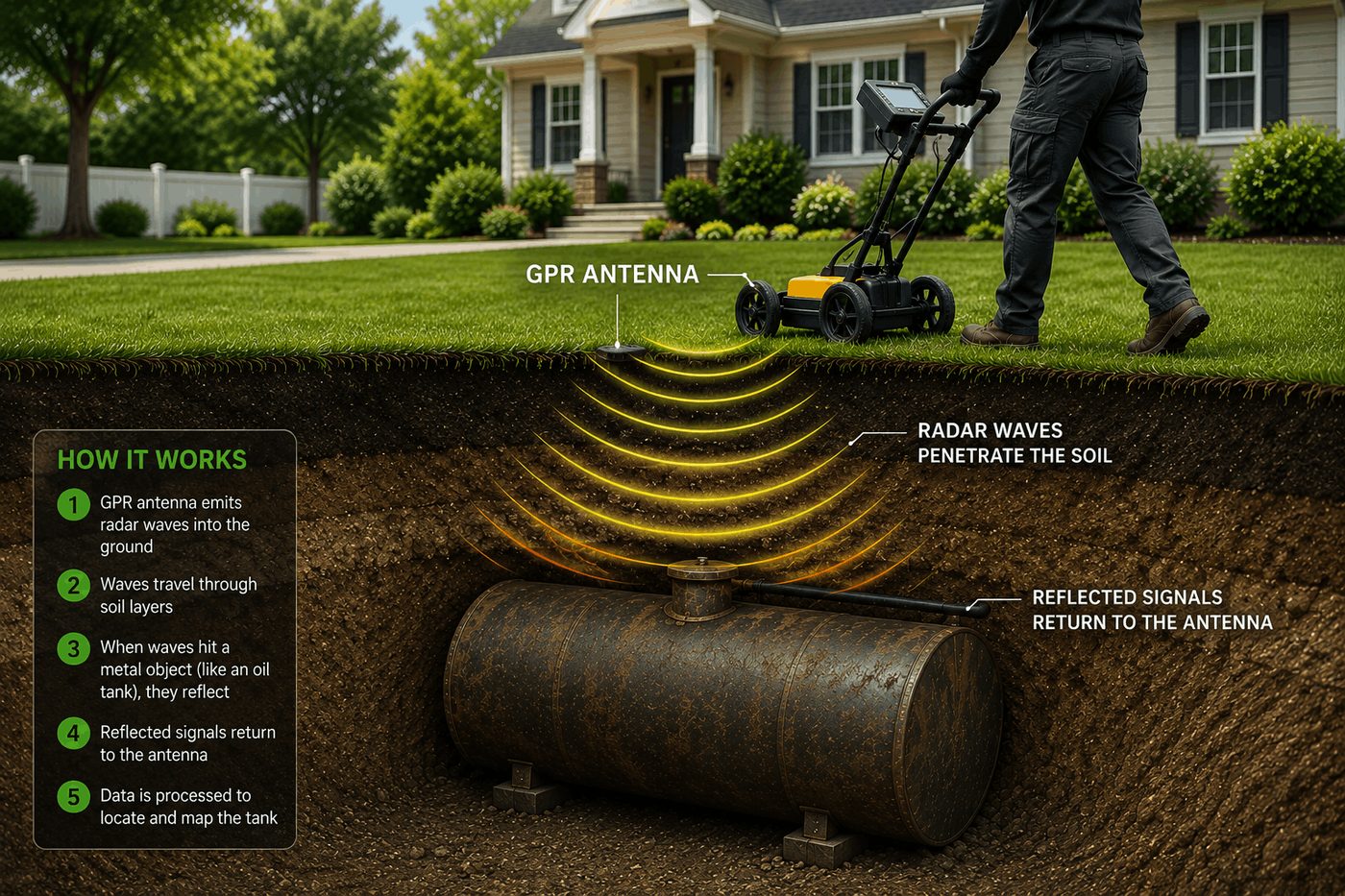
Homeowners and buyers ask about this constantly, and the honest answer rewards a little detail. The whole property is covered — yards, setbacks, driveways, and hardscape — not just a narrow band around the foundation. A technician reads the basement for capped lines and the exterior walls for fill and vent pipes before a single reading is taken.
Magnetic locating and radar are complementary: one excels at steel, the other at imaging disturbed soil and non-metallic anomalies. Abandoned supply lines, fill pipes, and vent pipes can be traced to where a tank is — or once was. Pair the sweep with your general home inspection to keep your timeline tight and your costs down.
What's really at stake
Environmental responsibility attaches to whoever holds title when a release is discovered, even with no prior knowledge of the tank. What looks like a minor surprise can quietly become the single largest unexpected expense a homeowner faces. Older estate and farm properties add outbuildings and acreage that give a forgotten tank even more room to hide.
Discovering a tank after closing means absorbing the full cost yourself, with no recourse to the seller. Contamination doesn't stay put; fuel oil can migrate toward groundwater and onto neighboring properties. There's a simple way to act on all of this.
Why New Jersey properties carry this risk
Older estate and farm properties add outbuildings and acreage that give a forgotten tank even more room to hide. Postwar suburban expansion across the region was built largely on oil heat before gas lines reached every street. Probing confirms the depth and material of any anomaly, separating a real tank from buried debris.
Because conversions happened gradually over decades, two neighboring homes can have entirely different tank histories. Estimates put the number of unknown or undiscovered underground storage tanks across New Jersey well into the six figures. Once you see the pattern, you can't unsee it on an older New Jersey home.
Putting it into practice
Put together, the picture is clear. On the question of “Oil Tank Sweeps in Hudson County's Urban Homes,” the practical move is the same: Keep the written report; in a future sale it answers a buyer's questions before they become a sticking point. Get the question settled early, because certainty is far cheaper than a surprise discovered mid-transaction.
How fast can NJ Oil Tank Scan help with my property?
We cover every town in Northern New Jersey and can often schedule within a day or two, with same-day written reports when a closing date is on the line. Call 973-559-2309 for a free, no-obligation quote and we'll confirm availability for your address.
Have questions about your specific property? We're happy to talk it through and recommend the right next step. Call 973-559-2309 or request a free quote.