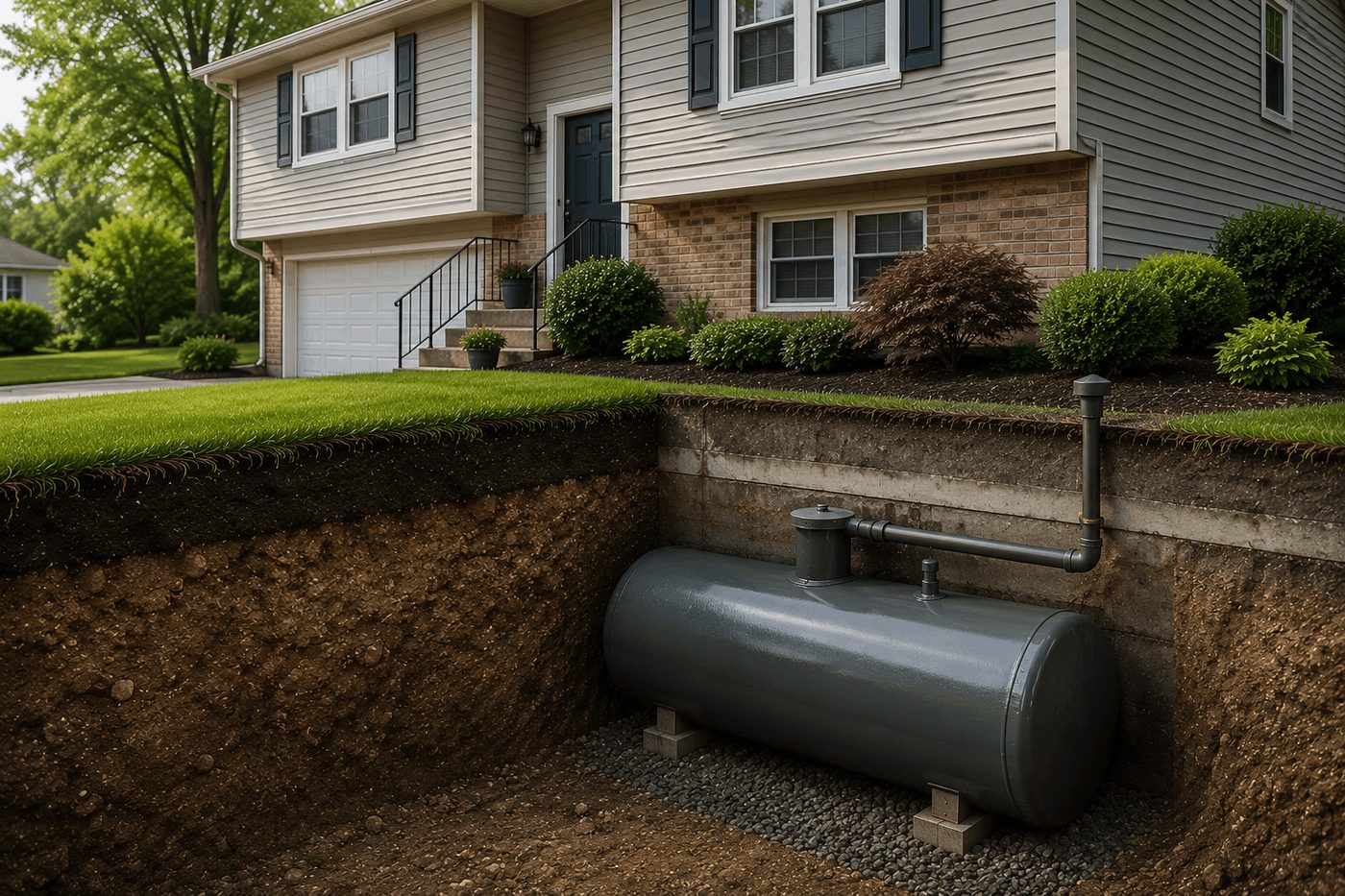
If you're buying or selling a home in New Jersey, you've probably heard the term "oil tank sweep" — and wondered whether you actually need one. The short answer is almost always yes. An oil tank sweep is a non-invasive inspection that determines whether an underground oil tank is hidden somewhere on a property, often long after the original owners switched to gas heat.
How an oil tank sweep actually works
A professional sweep combines two things: a subsurface scan of the entire lot using specialized detection equipment, and an expert visual inspection of the home and grounds. The equipment is far more sophisticated than a hardware-store metal detector — it's tuned to flag the large metallic mass of a buried storage tank while ignoring nails, pipes, and other small objects.
During the visual portion, our technician looks for the physical fingerprints a tank leaves behind: vent and fill pipes poking out of the ground, capped copper supply lines in the basement, patched areas of a driveway, or unexplained depressions in the yard.
Why New Jersey homes are high-risk
- Fuel oil heated NJ homes for over 75 years, so older neighborhoods are full of former oil-heat properties.
- The EPA estimates there are more than 100,000 unknown underground storage tanks still in the ground statewide.
- When owners switched to gas, many tanks were simply abandoned in place rather than removed.
- Sellers frequently have no idea a tank exists because it predates their ownership.
What you get at the end
After the sweep, you receive a clear written report documenting exactly what was found — or confirming that no tank-like anomalies were detected. That report is what real estate attorneys, lenders, and buyers rely on to move a transaction forward with confidence.
An oil tank sweep is one of the lowest-cost, highest-value inspections you can order during a NJ home purchase — a few hundred dollars to avoid a five- or six-figure surprise.
How the detection actually works
Understanding the mechanics here changes how you read a property. A technician reads the basement for capped lines and the exterior walls for fill and vent pipes before a single reading is taken. A professional sweep combines a subsurface scan of the entire lot with a trained visual inspection of the home and grounds.
A technician reads the basement for capped lines and the exterior walls for fill and vent pipes before a single reading is taken. Magnetic locating and radar are complementary: one excels at steel, the other at imaging disturbed soil and non-metallic anomalies. Get the question settled early, because certainty is far cheaper than a surprise discovered mid-transaction.
What's really at stake
Most homeowner insurance policies specifically exclude leaking-tank remediation, so the cost typically lands directly on the property owner. If a buried tank leaked, the new owner inherits the cleanup, which in New Jersey commonly runs from eight thousand dollars into the tens of thousands. Estimates put the number of unknown or undiscovered underground storage tanks across New Jersey well into the six figures.
A property with a known, unresolved tank issue is far harder to sell until the matter is documented and closed. What looks like a minor surprise can quietly become the single largest unexpected expense a homeowner faces. There's a simple way to act on all of this.
Why New Jersey properties carry this risk
The state's environmental agency maintains records around tank closure and soil remediation that a file review can surface. A tank installed in the 1960s and abandoned in the 1990s can sit silently underground while several owners come and go. A professional sweep combines a subsurface scan of the entire lot with a trained visual inspection of the home and grounds.
Older estate and farm properties add outbuildings and acreage that give a forgotten tank even more room to hide. When homes converted to gas, the visible furnace changed but the buried tank was frequently left in place. This is one of those topics where a small amount of knowledge saves a large amount of money.
Putting it into practice
Put together, the picture is clear. On the question of “What Is an Oil Tank Sweep? A Complete Guide for NJ Homeowners,” the practical move is the same: Keep the written report; in a future sale it answers a buyer's questions before they become a sticking point. For a time-sensitive closing, confirm same-day reporting is available before you book.
How fast can NJ Oil Tank Scan help with my property?
We cover every town in Northern New Jersey and can often schedule within a day or two, with same-day written reports when a closing date is on the line. Call 973-559-2309 for a free, no-obligation quote and we'll confirm availability for your address.
Thinking about a sweep on a specific property? We can usually schedule within a day or two and deliver same-day reports. Call 973-559-2309 or request a free quote.