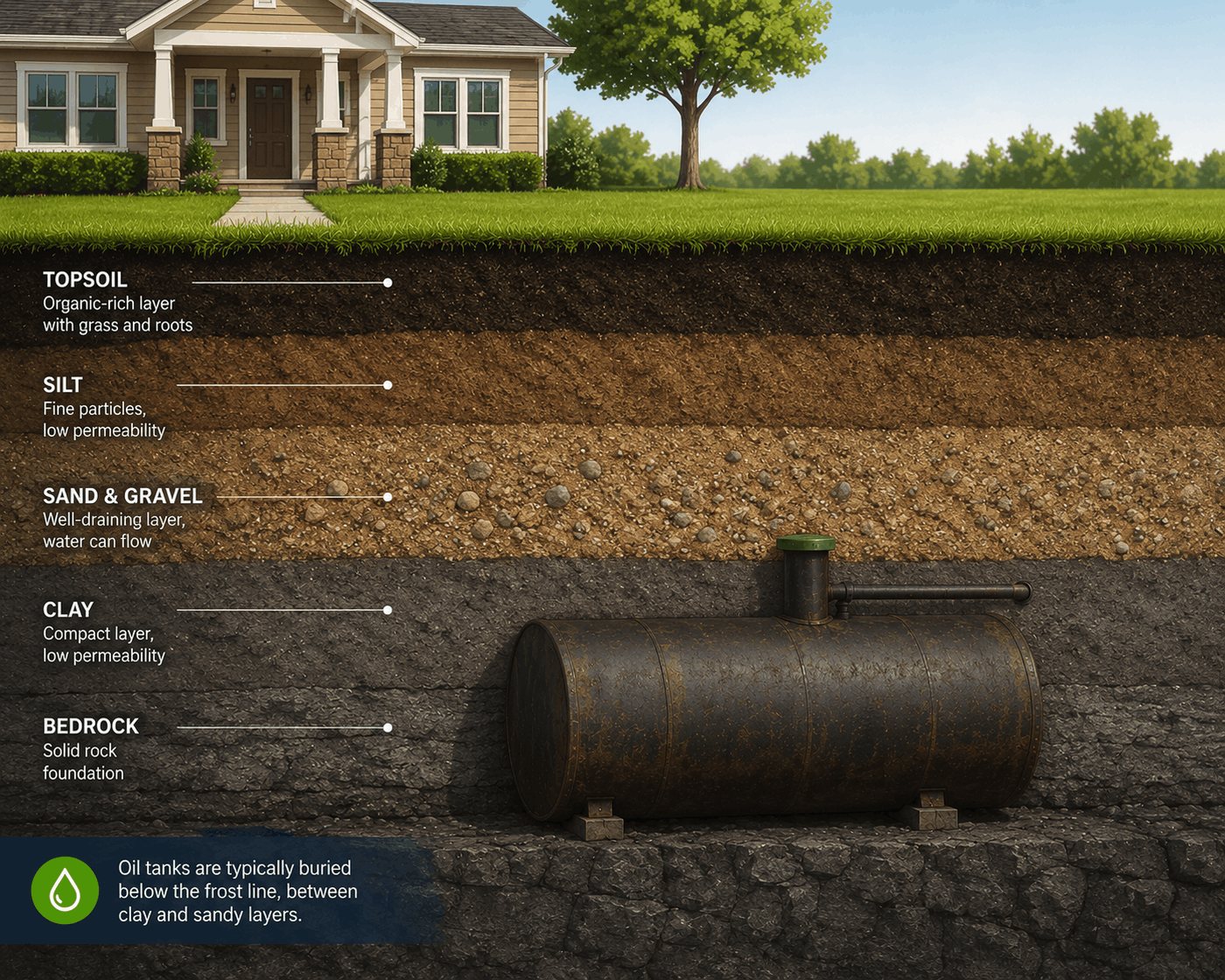
To understand why so many NJ homes have buried tanks, it helps to look at how the state heated itself for the better part of a century.
Why this matters in New Jersey
New Jersey's long history of oil heat means buried tanks turn up constantly — and the financial and environmental consequences of missing one are significant. That's the backdrop for everything in this guide.
Key things to know
- A professional sweep scans the whole property, not just a small perimeter.
- The visual inspection is as important as the equipment — clues matter.
- A clear written report is what attorneys, lenders, and buyers rely on.
- Timing the sweep correctly protects your ability to negotiate.
Our approach
At NJ Oil Tank Scan, we combine multiple detection methods with years of New Jersey-specific experience, then document everything in a report you can act on with confidence.
The goal isn't to alarm you — it's to give you certainty. Knowing what's underground is what lets you make a confident decision.
How the detection actually works
The details matter more than they first appear, so here's the full picture. Abandoned supply lines, fill pipes, and vent pipes can be traced to where a tank is — or once was. Experienced crews adjust the method to the property, because a tight urban lot and a wooded acre hide a tank very differently.
Magnetic locating and radar are complementary: one excels at steel, the other at imaging disturbed soil and non-metallic anomalies. When paved surfaces or additions complicate the scan, ground penetrating radar images the subsurface directly to fill the gaps. Ask any provider whether the scan covers the whole property and whether ground penetrating radar is included when needed.
What's really at stake
What looks like a minor surprise can quietly become the single largest unexpected expense a homeowner faces. Lenders and title companies grow cautious when a tank question is left open, which can complicate financing. A tank installed in the 1960s and abandoned in the 1990s can sit silently underground while several owners come and go.
Discovering a tank after closing means absorbing the full cost yourself, with no recourse to the seller. Most homeowner insurance policies specifically exclude leaking-tank remediation, so the cost typically lands directly on the property owner. Put together, the picture is clear.
Why New Jersey properties carry this risk
A tank installed in the 1960s and abandoned in the 1990s can sit silently underground while several owners come and go. The state's environmental agency maintains records around tank closure and soil remediation that a file review can surface. Detection equipment is tuned to flag the large steel mass of a storage tank while ignoring small metal objects that would confuse a basic detector.
The state's environmental agency maintains records around tank closure and soil remediation that a file review can surface. Postwar suburban expansion across the region was built largely on oil heat before gas lines reached every street. The details matter more than they first appear, so here's the full picture.
Putting it into practice
Here's how it plays out on a real property. On the question of “A Brief History of Underground Oil Tanks in New Jersey,” the practical move is the same: For a time-sensitive closing, confirm same-day reporting is available before you book. Compare quotes on what's included, not just the headline price, so a low number doesn't hide a perimeter-only scan.
How fast can NJ Oil Tank Scan help with my property?
We cover every town in Northern New Jersey and can often schedule within a day or two, with same-day written reports when a closing date is on the line. Call 973-559-2309 for a free, no-obligation quote and we'll confirm availability for your address.
Have questions about your specific property? We're happy to talk it through and recommend the right next step. Call 973-559-2309 or request a free quote.